'The financial sector will be hit even harder than the overall market.' 'The banking sector will eventually be rescued.' 'But it may go into a long downwards spiral before things turn around.' 'Threat or buying opportunity?' asks Devangshu Datta.
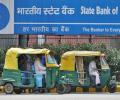
India's state banks are under pressure to improve profitability.
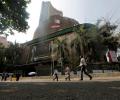
Nifty PSU bank index dropped nearly 2%
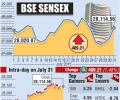
.jpg)
Banking as we know it will stand on its head in the next 10 years.
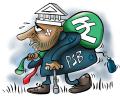
The banking sector's credibility is on thin ice. Unless the government takes strict steps, things could get worse.

There are NPAs on account of the industrial downturn in sectors like steel, infrastructure and power.

A fresh PIL was filed on Thursday in the Supreme Court seeking a probe by multiple central government agencies under the supervision of a panel or a former apex court judge against the Adani Group of companies following allegations of fraud and share price manipulation made by the US-based Hindenburg Research.
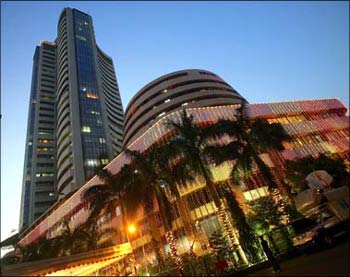
'There is no change in the overall story of economic recovery.'

The staff of public sector banks had gone on a nationwide strike for two days beginning February 10 after discussions with the IBA failed.

There are four public sector general insurance companies.
Among PSBs, the top gainers have been Union Bank of India and Corporation Bank, whose shares have rallied more than 15% each. Indian Bank and Bank of Baroda, too, registered double-digit rise

TCS was the top gainer in the Sensex pack, rising over 3 per cent, followed by HUL, UltraTech Cement, Nestle India, Kotak Bank, Dr Reddy's and Titan. NSE Nifty surged 157.90 points to 17,234.15.
The Securities and Exchange Board of India (Sebi) on Monday relaxed the norms for valuing perpetual bonds. The norms, which had sought to value banks' deemed residual maturity of Basel III additional tier 1 (AT1) bonds as 100-year debt from April 1, were strongly opposed by the finance ministry. In a statement released on Monday, the regulator said the maturity would be 10 years until March 31, 2022, and would be increased to 20 and 30 years over the subsequent six-month period.

The mergers will not involve any cash but only share swaps
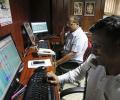
Among the gainers, RIL was followed by Sun Pharma, PowerGrid, Bajaj Finance, Nestle India and HCL Tech. On the other hand, Titan, L&T, ONGC, HDFC Bank and ITC were among the laggards.

rediffGURU Vivek Lala answers your income tax and personal finance queries.

Five state-run general insurance companies have a total exposure of Rs 347.64 crore, or 0.14 per cent of their total assets under management (AUM), in Adani group of companies, the finance ministry said on Monday. In a written reply to a question by Congress' Manish Tewari, Minister of State for Finance Bhagwat Karad said Life Insurance Corp (LIC) held Rs 35,917.31 crore in debt and equity of Adani group of companies as on December 31, 2022. This is 0.97 per cent of its total assets under management (AUM) of Rs 41.66 trillion.
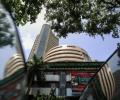
Both the Sensex and Nifty, however, registered gains for the week.
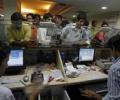
Asset quality stress has ballooned recently, as growth slowed and interest rates continued to rise.
'The effect will be seen two-three quarters down the line.'

The NSE Nifty settled the day 38.85 points or 0.37 per cent lower at 10,500.90 after shuttling between 10,590.55 and 10,456.65, intra-day.

The broader Nifty ended on top of 9,800 again.

'The household sector, which is still the largest contributor of financial savings, has been experiencing a decline in the last six years, and it has fallen below 8% of GDP.'

ONGC was the top loser in the Sensex pack, shedding around 4 per cent, followed by NTPC, PowerGrid, M&M, Nestle India, SBI and HCL Tech. On the other hand, HUL, Bajaj Auto, Bharti Airtel, Bajaj Finserv were among the gainers.
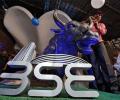
On BSE, 1,469 shares fell and 1,200 shares rose. A total of 190 shares were unchanged.

The International Cricket Council came in for sharp criticism for its bizarre rules on playing conditions

Government-owned companies are more generous in rewarding their shareholders with dividends.

Fresh buying by domestic institutional investors and better-than-expected June quarter results from some blue-chip companies boosted investor sentiment

Bankruptcy Code will consolidate existing laws related to liquidation and sick industries

'While GST and demonetisation are likely to cause disruption for longer than the market currently expects, they can have meaningful positive impact over the medium-term.'

HUL was the top gainer in the Sensex pack, spurting around 3 per cent, followed by Infosys, M&M, ITC, SBI, IndusInd Bank, Bajaj Finance, Asian Paints, TCS and Bharti Airtel. On the other hand, Titan, PowerGrid and NTPC were among the laggards.
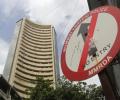
Nifty saw the biggest weekly gain since the first week of September and comfortably maintained its crucial 8250 levels in today's session

Metal stocks also had a good session, with JSW Steel zooming by 7%, and Tata Steel and Nalco gaining about 3% each.

The BSE Midcap index has declined 5.7% thus far in May 2018. In comparison, the S&P BSE Small-cap index has lost 5.6%

The gap between the highs and the lows in April for the benchmark S&P BSE Sensex was just 4.1 per cent - the narrowest since July 2021 and nearly half its three-year average. The absence of major positive triggers, sectoral rotation, and cautiousness due to earnings and economic uncertainty have kept a tight leash on the markets, observe experts. Remarkably enough, during the 17 trading sessions in April, the Sensex didn't even log an advance or a decline of more than 1 per cent.

Banking services are likely to be affected for the next four days as employees of PSU banks plan to go on a zone-wise relay strike beginning with Southern region from Tuesday, after wage revision talks failed.
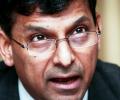
The central bank kept cash reserve ratio unchanged at 4 per cent.
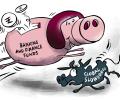
Invest only if you wish to go overweight on the sector.

From the Sensex pack, NTPC, Tata Motors, Larsen & Toubro, Bajaj Finserv, Bharti Airtel, HDFC Bank, Reliance Industries, Titan, Power Grid and State Bank of India were the major gainers. ITC, UltraTech Cement, Tech Mahindra, Tata Steel, Wipro, Tata Consultancy Services and JSW Steel were among the laggards.
